Showing posts with label Famous Hoosiers. Show all posts

Sunday, October 2, 2011

Tippecanoe Place


While visiting family in South Bend, we found time to discover three treasures of North-central Indiana. Our first stop was to the historic Tippecanoe Place, but to the long time residents of this area it will always be known as the Studebaker Mansion.

As we are not local residents we have heard of the Studebaker Mansion, however had little to no actual knowledge of it. In attempting to do pre-travel information gathering we were constantly frustrated in our inability to locate the ‘Studebaker Mansion.’ There is little online that correlates the ‘Studebaker Mansion’ and ‘Tippecanoe Place.’ It was only once we called the Studebaker Museum (another stop during our visit in South Bend) that it became clear that the two names were synonymous.

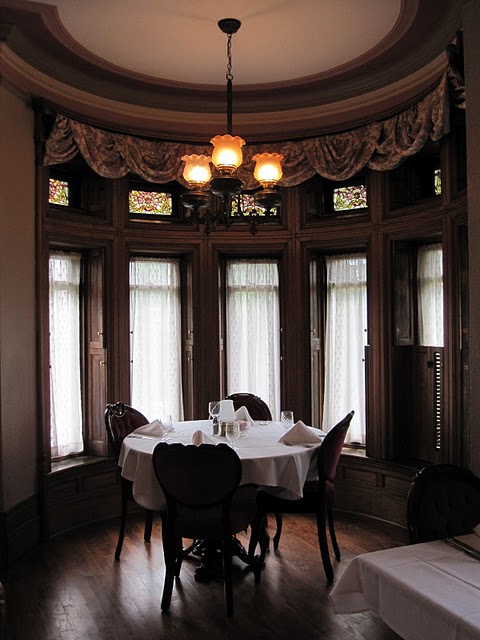
The Studebaker family lost the residence in 1933 due to bankruptcy and for years the building stood unoccupied. In the early 1980’s the mansion began it’s long transition from a once grand forgotten home, into the space that now houses the restaurant known as Tippecanoe Place. Tippecanoe place serves lunch and dinner year-round and is also a favorite venue for special events.

As we travel the state we tend to favor visiting historic homes as points of interest and as such our expectations of the Studebaker Mansion were that of a historic home; In reality there are two perspectives that must be considered when reviewing Tippecanoe Place. The first is the quality and ambiance offered as a unique dinning experience. The second perspective is more obvious, that of a historic home visitation.

In order to tour the home, you must also be dining with Tippecanoe Place. We made lunch reservations in order to keep the cost down, while still being permitted to tour the premises. As we travel we look for ways - like choosing lunch over dinner - as a way to lower our travel costs.

Our favorite two parts of the meal were the beginning and the end. We ordered Tippecanoe Place’s take on Baked Brie. The chef chose to bake it in puff pastry, drizzle it with raspberry sauce, and then plated the brie with sliced green apples and red grapes. Dessert was delicious.  We decided to split a large slice of Carrot Cake and it certainly did not disappoint.

In a true juxtaposition to the amazing brie and cake, the entree was far less appetizing. The steak we were served was nearly raw. When brought to the attention of the waitress we were simply informed that that was how Tippecanoe Place prepared their steak. No attempt at resolution was made, in fact the waitress brought someone else’s steak to our table to ‘prove’ to us that ours was properly prepared before serving it to the intended party - who promptly questioned whether it was cooked enough.

Once the residence of the historic influential Studebaker family, we felt that this would be one of the grander stops we would encounter during our Indiana travels.

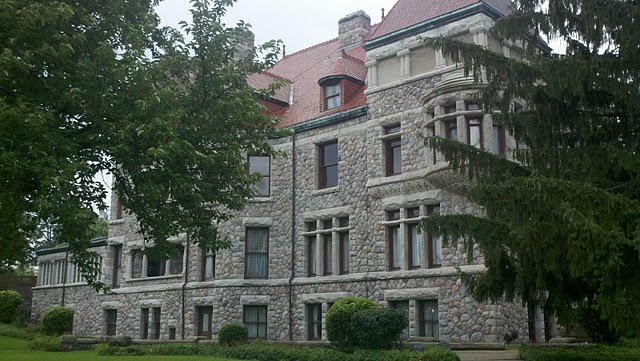
The exterior, and most of the home’s structure, is intact. The home is listed on the National Register of Historic Places as a “Richardsonian Romanesque” home. Indeed you can visually identify the stone massings, recessed entrance, and arches that are commonly associated with this style.

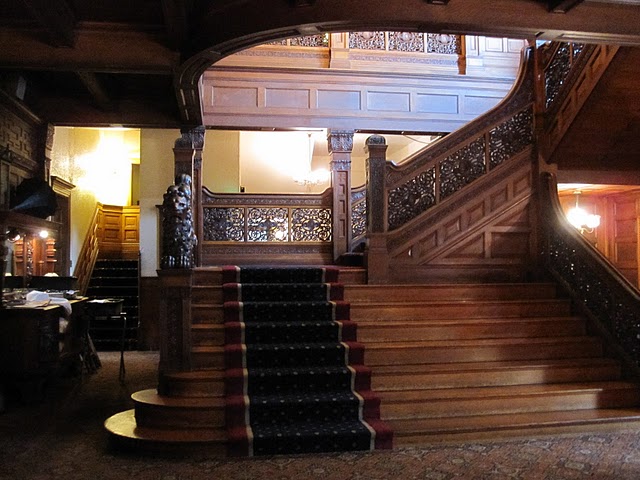
The home has only retained some of the original flourishes that indicate it once existed during a grander time. The exterior of the home is generally as it was built to be, however the interior of the home has been basically gutted for use as a restaurant. Some of the original wordwork, fireplaces, and framing still exist, yet as a historic home visit, this was rather disappointing. An entire room has been walled off and basically destroyed to create a fire-escape allowing the restaurant to serve meals on the fourth floor. According to the staff, the room once contained the most beautiful fireplace of the entire home. How this building is still listed on the National Register of Historic places befuddles us.

While we are confident that the overall experience will excite and thrill some visitors, we were disheartened and frustrated. The dinning experience was good, yet we were heartbroken by the state of the mansion. As a restaurant the wood flourishing and detailed craftsmanship are truly unique. We even tried to understand that a historic society, or a group attempting to maintain a historic building, may need to use the restaurant service as a means for income; however, interior walls have been removed in order to construct a modern bar on the second floor - to us this was the most appalling aspect.

Tippecanoe Place is located within South Bend’s historic district and is only a few blocks away from the new Studebaker Museum. The home has plenty of parking located on property. Simply enter the driveway to start your visit. There is no cost to tour the home, however we recommend that you let your server know at the start of the meal that you intend to tour the mansion, so that they have ample time to provide the self-guided tour pamphlet.

Sunday, July 31, 2011

Eugene and Marilyn Glick History Center: The Indiana Experience


While walking into the Eugene and Marilyn Glick History Center you walk past a clock going back in time, which we found to be very intriguing and set the tone for what we were about to experience next. Much of the Glick Center’s presentation involves sending visitors back to specific moment in Indiana’s history.

The three “You Are There” exhibits are based extensively on visitor participation, so come prepared to engage the actors and ask questions “in character”. Each of the “You Are There” exhibits begin with a photo from the Historical Society’s collection that has been converted into a fog portrait. To enter the experience you step through the photo into a themed set.

Destination Indiana
The first exhibit you come to is called Destination Indiana. When you enter the exhibition hall you are met by a large projection screen that is playing a selection of eight small informational videos covering a wide array of Indiana specific information.The topics range from the mapping of Indianapolis to Traction Terminal. Following the informational videos there are a number of two to three person screens that will build upon the topics that were covered in the larger production.  

You Are There: The Violin Maker Upstairs (1914)
On the second floor of History Center you will find Joseph Conrath carving out the body of his next violin. His sister is in town along with his wife who helps run the music shop where they sell and repair string instruments. This experience was the most personal of the day, in that we were personally invited in and asked to make ourselves comfortable. The dialogue was more of a period conversation rather than a presentation and we were greatly in control of the overall experience. A key moment in our visit followed Nicholas’ response that he was not allowed to play the violin as a child due to the noise it would produce. Mr. Conrath appeared to take great offense to this comment and over the next few minutes taught Nicholas to play a little ditty. It was a legitimate process, definitely not the Professor Hill “Think Method.”

Some topics that you may consider discussing with the Conrath’s: “How much do violins cost?”, “Did Joseph’s sister use the interurban on her journey to visit?”, or “How long would the process of creating a violin take?”. It is useful to have a general knowledge of music for this experience, but those without it are not at any great disadvantage.

You Are There: Busted! Prohibition Enforced (1920)
Prohibition was and has always been a controversial topic, but in 1920 there was no discussion.  The transportation and sale of liquor was illegal in all ninety-two Indiana counties as well as across the nation. The fog portrait that is your portal to the prohibition experience, is a moment captured right after Indiana police officers have arrested a man for making and selling homemade moonshine. You will have an opportunity to see the distillery and visit the poor chap locked up in jail along with the man responsible for his incarceration. Feel free to play along with the experience, the more you ask, the better your experience will become.

You Are There: Robert F. Kennedy Speaks (1968)
April 4, 1968 was a long day for Robert F. Kenney. After entering the presidential race late, his first primary was in Indiana and he was hitting the campaign trail hard. He began is day with a speech to students at the University of Notre Dame in South Bend. He delivered a second speech to students at Ball State University in Muncie. But his most important speech came two hours later than planned in Indianapolis. This was the day that Martin Luther King Jr. was assassinated. Kennedy addressed speech goers from the heart. His speech in Indianapolis is considered to be one of his most heartfelt and profound speeches during his campaign. It is this heartfelt speech which visitors experience during this “You Are There” exhibit. Just two months and one day later, after winning his primary bid, Robert F. Kennedy was assassinated in Los Angeles on June 5, 1968.

Cole Porter Room
The Cole Porter room is a replica of the Waldorf-Astoria hotel lounge. This exhibit is not a “You Are There” exhibit, rather you enter the lounge and can listen to a local artist sing Porter’s songs while you view photos and read stories about his life. While Porter was a world-traveler and a famous Hollywood personality, he was first a Hoosier.

W. Brooks Fortune History Lab
We tend to abstain from participating in the children focus activities currently, however the Fortune history lab had a variety of hands on historical activities for young - and the young at heart.

Stardust Terrace Cafe
The Glick Center has a lower level cafe. We choose to split our visit into a few exhibits, lunch, and then finished the remaining exhibits. We found this approach worked best for us. The cafe offers sandwiches, salads, and a few hot selections. While the meal wasn’t the greatest, being able to sit on the terrace watching canal goers was a very enjoyable past-time.

Library
The Eugene and Marilyn Glick History Center is home to the Indiana Historical Society and also houses their historical records collection. To visit the library all you must do is check-in at the front desk and let them know your intentions, and they will give you a pass to head up to the library and begin your research. You are not charged admittance to use just the library. There are a handful of computers also set up in the library equipped with Ancestry.com where you can work on your family genealogy Tuesday through Saturday, 10 a.m. to 5 p.m.  

~  ~  ~

In conclusion, there is plenty of content for you to experience so we recommend arriving during the first few hours of the day to ensure that you have enough time. Video, fog (for picture entrances), and some other special effects may be utilized to enhance the experiences.

We viewed the exhibits in a somewhat random order but wish that we had viewed the video presentation in Discovering Indiana first to provide us a platform of information for the remaining exhibits. Should we visit again, which we would very much like to do, we would start with Discovering Indiana, and then progress chronologically through the “You Are There” exhibits.

The Glick Center has a strong family friendly atmosphere and definitely has activities for children however, some of the subject matter and format of presentation may be lost on some of the youngest attending visitors.

Entrance to the Eugene and Marilyn Glick center for Indiana History is $7.00 per adult and that grants access to the Indiana Experience exhibits. Parking starts at three dollars and increases hourly. If you dine in the cafe and your purchase exceed seven dollars, then keep your receipt and stop by the main desk to have your parking validated.

General Lew Wallace Study


The Lew Wallace study isn’t a massive nor grand facility when viewed from afar; but when considering the context that this entire building was constructed as a study for Wallace and not necessarily a habitable space, it becomes much more massive. Technologically cutting-edge for its time it has over 90 electric light bulbs installed and protruding from plaster flowers amongst other innovations.

Lew Wallace is the author that penned one of the most iconic books of all time: Ben-Hur: A tale of the Christ, which was originally published in 1880. The story itself was a blockbuster seller and has been made into three feature films, an animated film voiced by Charlton Heston, and a Broadway play. The 1959 feature film starring Charlton Heston won 11 academy awards - the first film to do so. Only two other films have since captured this many honors: Titanic (1997) and the Lord of the Rings: Return of the King (2003).

Lew Wallace himself designed the structure to meet his fantastic desires and was known to refer to it as “a pleasure-house for my soul.” The original structure even had a partial moat stocked with fish so that he could sit on the stairs and engage in his favorite past time. In bad weather he could open round windows and fish from the basement of his study as well.

The interior is a cavernous space lined with bookshelves and artwork. The study is currently undergoing renovations and during the process the curators performed paint analysis, uncovering extensive murals and discovering that all the decorative molding was originally painted with 24 karat gold leafing. The large domed skylight ceiling is very indicative of the early industrial period’s building designs. Although the site is currently undergoing some structural renovations, it is still open to the public and worth the visit.

The building now contains roughly 1,200 volumes from Wallace’s personal library and many artifacts from his personal life. Since the study also serves as a museum to Ben-Hur, items related to the Ben-Hur cannon are on display as well.

Entrance to the museum is $5.00 but parking is free. The grounds of General Lew Wallace’s study are surrounded by a large brick wall. The parking lot is not immediately obvious, however on the east wall there is a gated entrance. During open hours you drive in through the gate and park to the right. The yellow carriage house is where your tour will begin.

Lane Place Antebellum Mansion


Henry S. Lane was a politician, lawyer, banker, and early Indiana statesman. Lane moved to Crawfordsville, Indiana from Kentucky to live in a “free” state. He opened a law practice and entered politics. Lane is known for serving the shortest term for the post of Governor of Indiana - just 2 days before he resigned to be a U.S. Senator. Lane was also known for playing a leading roll in support of Abraham Lincoln’s candidacy for President of the United States.

Lane’s home, known as Lane Place, is a varietal collection of personal items and period pieces. It is maintained by the local historical society and as one of the older homes that we have visited thus far, it is in wonderful condition. Initially built in the mid-1840s the home mixes both Federalist and Grecian architectural stylings for the exterior.

Some of the most surprising elements of visiting historic homes tend to be the artifacts they contain. Often times the toys that children played with are some of the most surprising elements. To be able to have been played with, loved, and still be in the great condition that they are speaks volume to the children’s character of the time.

For Lane Place, as with the Harrison home, some of the most significant artifacts are those that relate to Lincoln; more specifically those that relate to Lincoln’s funeral and funeral train. The home contained Lane’s top hat from the funeral, as well as funeral ribbons and photographs.

Our guide and her young granddaughter showed us through the house. It was one of our most engaging home tours to date. Parking was a bit curious for us. We parked across the street to the north of the house. There appeared to be some street parking available as well. The tours begin at the front door of the home by ringing the doorbell. The tour costs $3.00 per person but we also recommend picking up the booklet that expands on the history of the home and artifacts it contains, for five extra dollars.

Saturday, May 21, 2011

Benjamin Harrison Home


The Benjamin Harrison home is a definite must for the Indiana historian. The home is in excellent condition currently, although I am quite remiss in saying that while approximately seventy-five percent of the house’s contents are period correct, a much smaller percentage was specific to the family. The home is very much a museum to both the President and the time, which is in contrast to the James Whitcomb Riley home whose mission is to maintain the authenticity of the home, the contents, and the story. The two homes are very much from the same time period and therefore we tended to juxtapose the two during our visit.


President Harrison received many gifts both during his time as a practicing lawyer and as President of the United States. A great number of the items, some of which are highly unique, are located at the home for public viewing. A couple of these gifts can be found in the first floor library, including a larger-than-life bookcase that was built inside the home, in pieces, because of its incredible size. The bookcase now holds a great deal of the President’s personal books and references for his law practice.  You will also see a rather unique chair made out of animal horns and Bobcat hide (not to be easily forgotten) gifted to Harrison from one of his Texan clients.  


One of the most exciting elements of the tour can be found in the Back Parlor.  Our tour guide played a disc of Beethoven on an antique Reginaphone that belonged to the family, demonstrating the sound quality that still remains after so many years. It was quite unexpected and pure entertainment.   


There is an eery awareness in the President’s master bedroom when you find out that Harrison passed away on that very bed in 1901.  Another point of interest in the room was the portable gym owned by the President.  A portable gym was an item for the upper classes of the time. The case held a variety of wooden dumbbells and a pulley system for weightlifting. 


President Harrison is known for being the President to have electricity integrated into the White House; it is no small surprise that his home does also display the technology. While there were a number of “modern” additives, the home didn’t feel exceptionally innovative. One important technology definitely absent from the home is indoor plumbing.


The Harrison home was renovated and rededicated around 1960 and is highly accessible to the public. With the exception of one room, tours are able to enter all rooms that are a part of the experience.  


We visited both the James Whitcomb Riley home and the Benjamin Harrison home on the same day. The visit to the Harrison home takes about 90 minutes and tours begin on the hour and half hour. The entrance fee is $8.00 per person ($7 with AAA and $6 for seniors) and the museum accepts both cash and charge. We definitely recommend arriving 15 minutes before your tour to view the home’s exterior. The Harrison home is mostly handicap accessible and includes an elevator - however there are stairs that must be traversed in order to enter the home. The grounds do contain a carriage-house that is a reproduction built upon the original foundation. The carriage-house is not a part of the standard tour, however our guide mentioned that upon request they would be more than happy to show us the building. 

James Whitcomb Riley Museum Home


The James Whitcomb Riley home was tremendously enjoyable to visit. James Whitcomb Riley was an accomplished poet and author. Born in Indiana, he is one of the Hoosier State’s most prominent citizens of old. Great pains have been taken to preserve the house as it was in 1916 when the poet reposed. The house is still in the original condition, and with the exception of a few rare pieces of furniture, the contents originally belonged to the home; those that weren’t originally a part of the home were items that belonged to Mr. Riley and were donated back to the estate.


528 Lockerbie Street was the home of Mr. Riley for the last 23 years of his life, however he was not the owner of the home.  John R. Nickum built the home in 1872 for his wife and daughter.  Later, in 1893, Mr. Riley moved in with the family and lived there until his death.  The house is a fascinating look into a very technologically savvy Victorian home.  The home was run on three types of energy:  coal, natural gas and later the family had electricity installed.  The house also boasted indoor pluming (both hot and cold water), and an early intercom system throughout the home. 


Each room of the home had new and interesting characteristic that made it unique. From the foyer to the servant's quarters and back down into the kitchen, we felt well informed and impressed by the home itself and the knowledge of those showing us each and every detail the home had to offer it’s guests.


Of course Mr. Riley’s room was a highlight of the tour.  Possessions of his, including handwritten first editions of his works, are displayed throughout the room and give the visitor a glimpse into his world.  However, not to be overlooked is the tangible expression of how the family of the home chose to live their lives.  Charity was a large portion of their every day.  Generosity overflowing throughout the home from the obvious fact of Mr. Riley’s presence to the quarters provided to their live in help (the servant’s quarters having the luxury of running water while the master bedroom lacked that feature).Unlike other historical sites, you are able to peek into each room of the home, thoroughly satisfying even the most curious. Not all rooms are visitors able to enter, but that hardly detracts from the ability to observe and enjoy. Details are the key to your visit at the Riley home. Be sure to take your time, observe, and ask plenty of questions.The tour itself is not free and is a cash-only event, however the information and experiences are well worth the $4.00 per person entrance fee. Photos are not permitted within the home, however there are a number of postcard photos available for purchase at the end of the tour. Tours are available during the open hours. There are a number of stairs and steps and the facility isn’t set up for those with mobility issues. Parking is on the side of the house and you enter through the front after ringing the doorbell. Visit http://rileykids.org/museum for more information.


The last stanza from Mr. Riley’s Little Orphan Annie:


An' little Orphant Annie says, when the blaze is blue,
An' the lamp-wick sputters, an' the wind goes woo-oo!
An' you hear the crickets quit, an' the moon is gray,
An' the lightnin'bugs in dew is all squenched away, -
You better mind yer parunts, an' yer teachurs fond an' dear,
An' cherish them 'at loves you, an' dry the orphant's tear,
An' he'p the pore an' needy ones 'at clusters all about,
Er the Gobble-uns 'll git you
Ef you
Don't
Watch
Out!